As of late 2026, WordPress powers roughly 39% of all websites globally and about 58% of the identifiable content management system (CMS) market. While its overall share of the entire web has seen a slight decline from its 2025 peak, it remains the dominant platform by a wide margin. This guide breaks down the latest usage statistics, compares WordPress against competitors like Shopify and Wix, and explains what these shifting numbers mean for your website strategy.
What Is the Current WordPress Market Share in 2026?
Different research firms measure the web differently, which is why you might see varying numbers depending on the source. According to W3Techs, whose survey was updated on 7 November 2026, WordPress runs on 39.4% of all websites. When we exclude sites with no detectable CMS (like hand-coded pages or custom applications), the same data shows WordPress holds a 58.2% share of the identifiable CMS market. In W3Techs’ own words: "WordPress is used by 58.2% of all the websites whose content management system we know."
Meanwhile, the HTTP Archive Tech Report API (using April 2026 data) detects WordPress on 33.21% of measurable web origins. This lower percentage occurs because the HTTP Archive counts subdomains separately and limits its sample to sites in the Chrome User Experience Report, which excludes very low-traffic sites.
Regardless of the methodology, the core takeaway is consistent: WordPress is the most widely used CMS in the world. The WordPress.org directory lists over 78,000 free plugins and 15,000 free themes, supporting an ecosystem that scales from simple personal blogs to complex, high-traffic enterprise applications.
How Does WordPress Compare to Shopify, Wix, and Squarespace?
Blogs Wizards
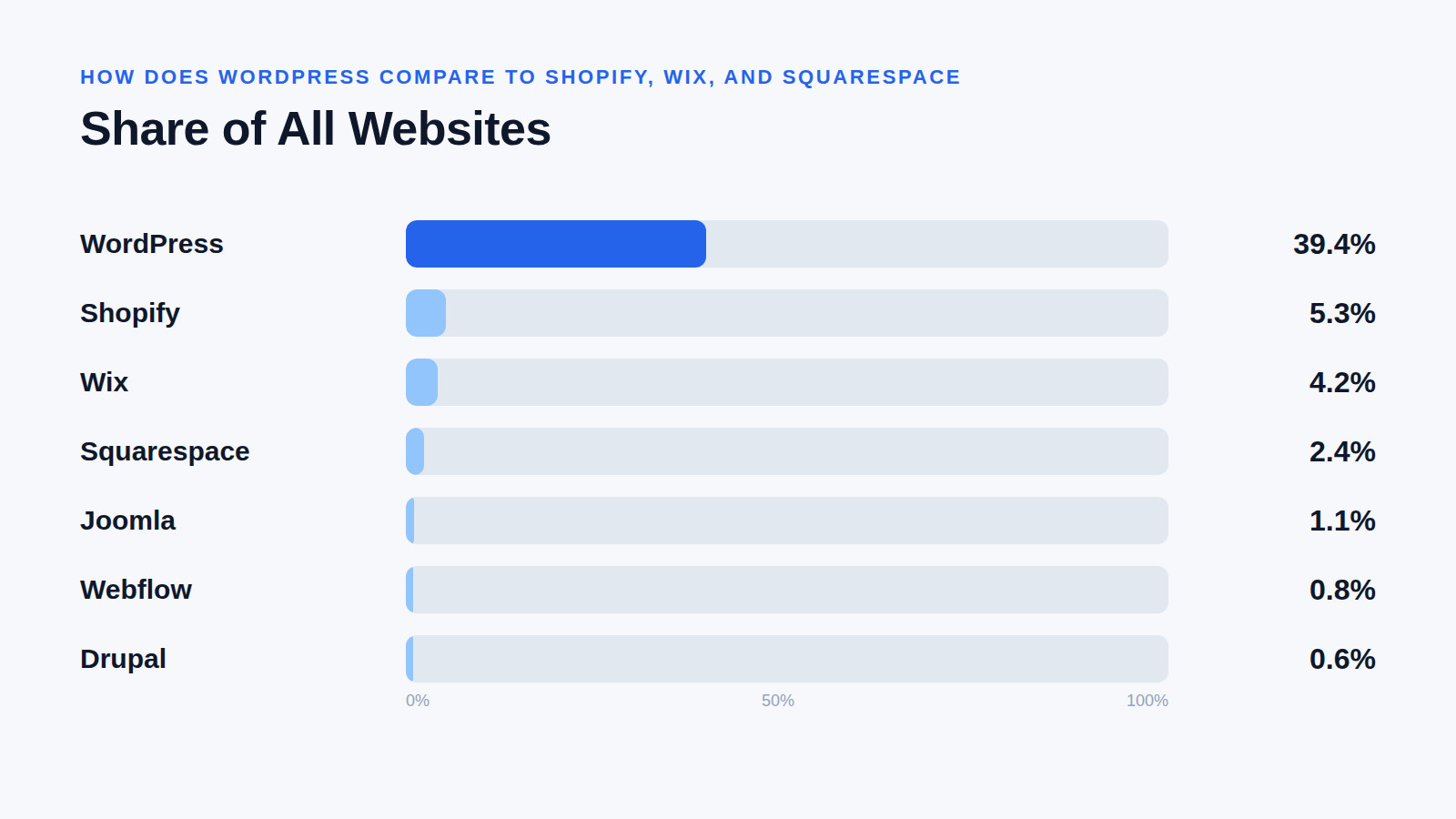
To understand WordPress’s dominance, we need to look at how it stacks up against hosted website builders and specialized platforms. Based on W3Techs’ CMS survey of 7 November 2026, here is the market share breakdown for the top CMS platforms across all websites:
| CMS Platform | Share of All Websites |
|---|---|
| WordPress | 39.4% |
| Shopify | 5.3% |
| Wix | 4.2% |
| Squarespace | 2.4% |
| Joomla | 1.1% |
| Webflow | 0.8% |
| Drupal | 0.6% |
WordPress is more than seven times larger than its closest competitor, Shopify. While platforms like Wix and Squarespace are popular for quick, template-based builds, they lack the deep, open-source extensibility of WordPress. Traditional open-source alternatives like Joomla (1.1%) and Drupal (0.6%) continue to lose ground, collectively accounting for less than 2% of the web.
Is WordPress Losing Market Share?
Yes, but the context matters. WordPress reached an all-time high of 43.6% of all websites in January 2025. Since then, W3Techs data shows a steady decline, dropping to 41.90% by May 2026 and to 39.4% by early November 2026.
This marks the first meaningful, sustained decline in over a decade. The reasons are multifaceted. One likely factor is the rise of AI site generators and no-code builders, which suit the simple, single-page sites that might once have used a basic WordPress install, although no survey yet measures how many sites have moved. Another is that community trust has faced friction. As Pravin Kumar noted in April 2026, governance disputes—specifically the high-profile conflict between Automattic and WP Engine that began in late 2024—have caused some agencies and business owners to re-evaluate their reliance on a platform where central repository access can be restricted.
However, a drop of a few percentage points in overall web share does not mean the platform is failing. It indicates a market maturation where WordPress is consolidating its position as the go-to choice for custom, complex, and high-traffic sites, rather than simple brochure pages.
WooCommerce vs. Shopify: Which E-commerce Platform Leads?
Blogs Wizards
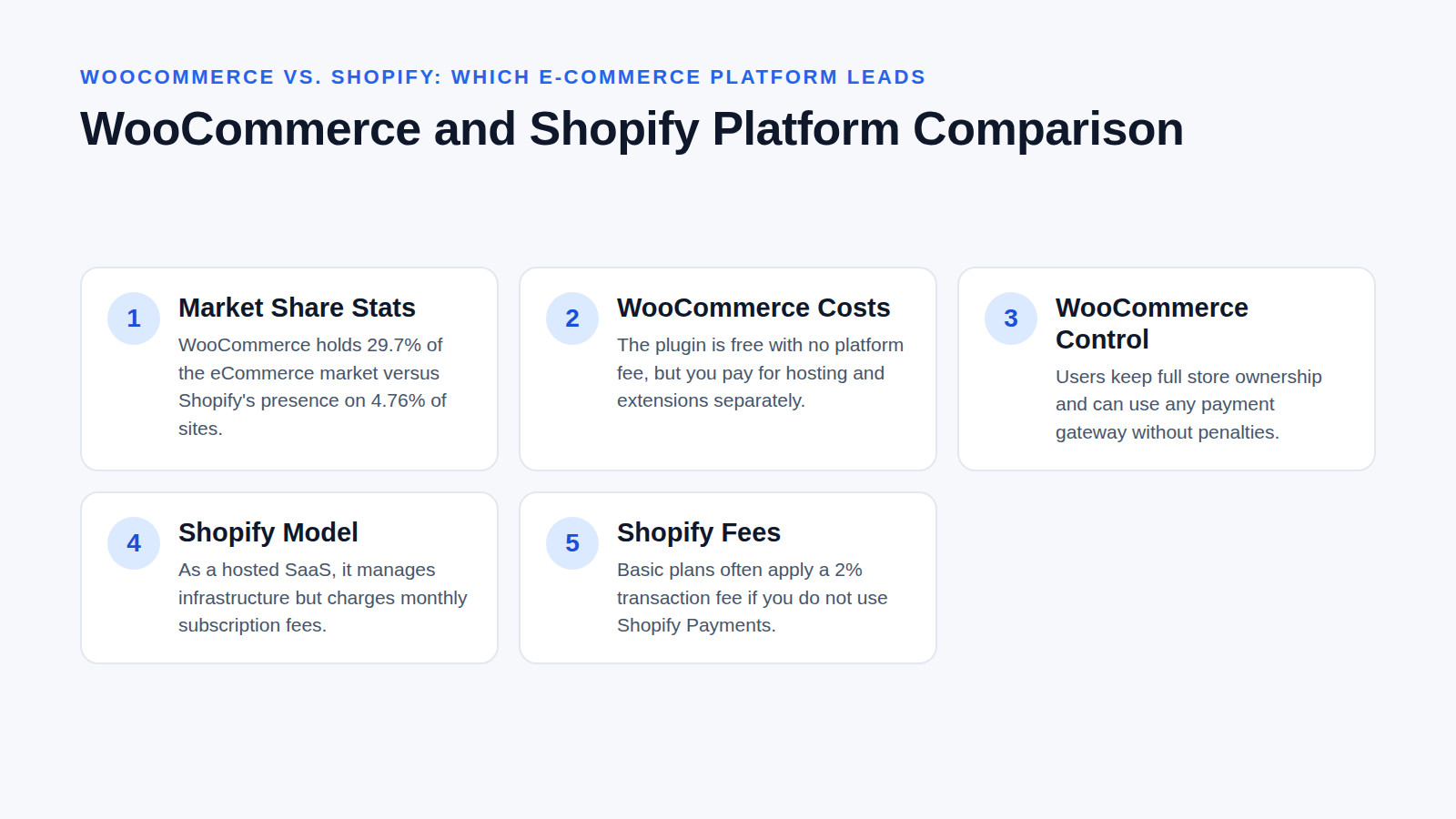
When we narrow the focus to e-commerce, the competition tightens, but WordPress still holds a massive footprint through WooCommerce. According to WPZoom’s September 2026 statistics, WooCommerce holds a 29.7% share of the overall eCommerce market. Looking at the broader web, the HTTP Archive detects WooCommerce on 6.64% of measurable sites, compared to Shopify’s 4.76%.
The choice between the two usually comes down to how you prefer to manage costs and control your data. WooCommerce is a free, open-source plugin with a $0 platform fee. As the official WooCommerce pricing page states:
"WooCommerce doesn’t believe in taxing your growth. There’s no revenue share, and we don’t lock features away behind higher-priced plan tiers."
You pay for your own hosting, premium extensions, and payment processing (like WooPayments, which charges roughly 2.50% to 2.90% + 30¢ per transaction), but you keep full ownership of your store and can use any payment gateway without penalties.
Conversely, Shopify is a fully hosted SaaS platform. It handles your hosting, security, and checkout infrastructure out of the box, which simplifies initial setup. However, Shopify charges monthly subscription fees (new stores get a 3-day free trial, then pay $1 a month for the first 3 months before standard pricing applies) and applies additional transaction fees (often 2% on basic plans) if you do not use their proprietary payment gateway, Shopify Payments.
What Page Builders and Plugins Power WordPress Sites?
Blogs Wizards
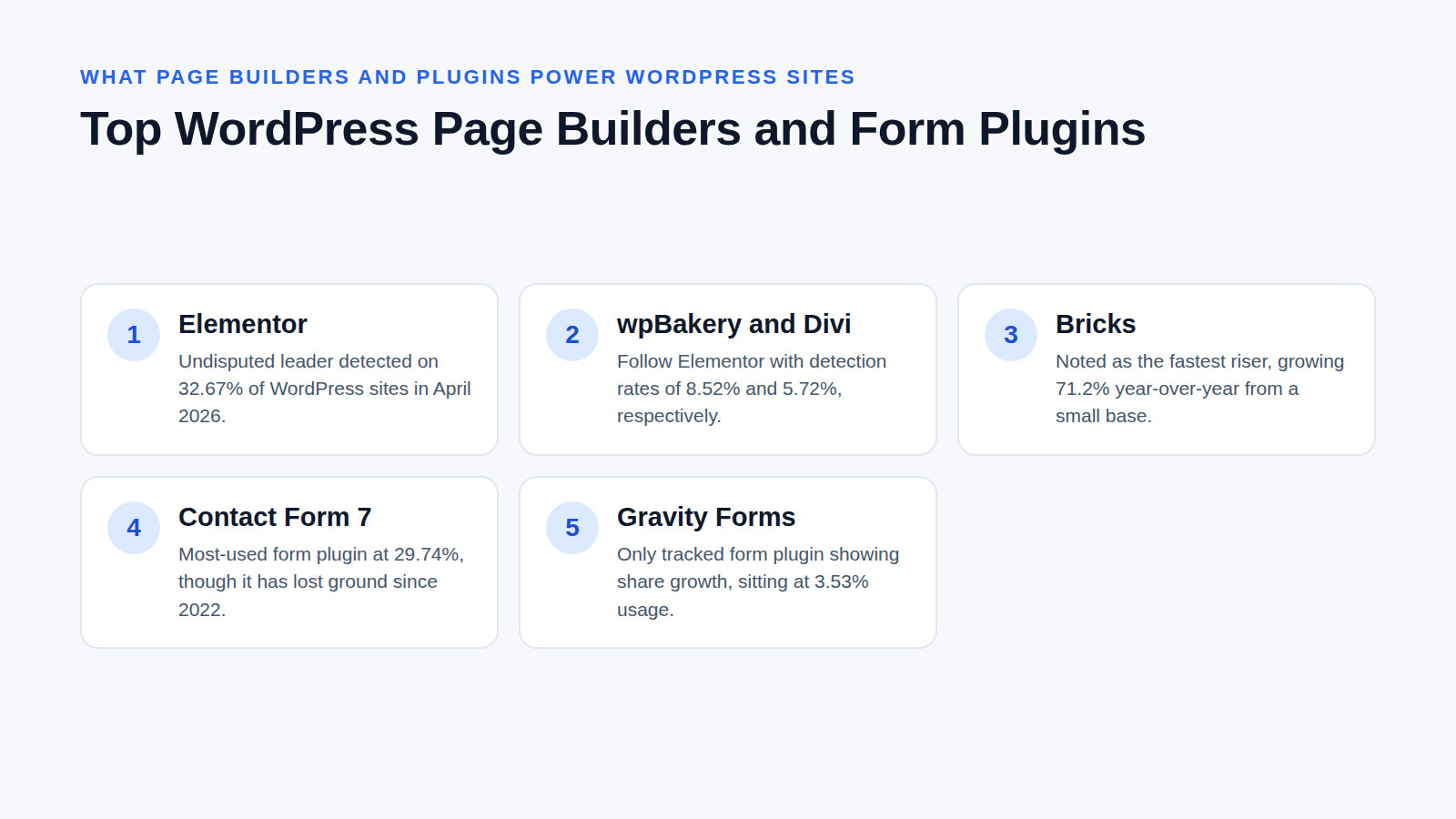
The WordPress ecosystem relies heavily on third-party tools to extend the core Gutenberg block editor. According to HTTP Archive data from April 2026, Elementor is the undisputed leader among page builders, detected on 32.67% of WordPress sites.
Here is how the top page builders compare within the WordPress ecosystem:
- Elementor: 32.67%
- wpBakery: 8.52%
- Divi: 5.72%
- Bricks: Noted as the fastest riser, growing 71.2% year-over-year from a small base.
In the form builder category, Contact Form 7 remains the most-used plugin, detected on 29.74% of sites, though it has lost ground since 2022. Gravity Forms is the only tracked form plugin showing share growth, sitting at 3.53%.
What This Shift Means for Your WordPress Strategy
For bloggers, small business owners, and agencies, a slight dip in overall market share is not a reason to panic or migrate. Instead, it clarifies where WordPress truly excels today. The lost share appears to be going mostly to AI builders and simple drag-and-drop tools aimed at users who need a basic digital business card.
If you are running a content-heavy blog, a complex membership site, or a highly customized WooCommerce store, WordPress remains unmatched. The practical takeaway for site owners is to double down on what makes WordPress powerful: performance, security, and deep customization. Invest in high-quality managed hosting, keep your plugins updated, and utilize advanced caching to ensure your site outperforms the simpler, template-locked sites built on competing platforms.
Checklist for WordPress Site Owners in 2026:
- Audit your plugins: Remove unused plugins to reduce security risks and improve speed.
- Evaluate your page builder: If you are using a heavy builder, consider if core Gutenberg blocks or a lighter alternative like Bricks can improve your load times.
- Secure your checkout: If using WooCommerce, ensure your payment gateway is optimized for conversions and that you are not paying unnecessary third-party transaction fees.
- Back up your data: Always maintain off-site backups, especially given the shifting dynamics in plugin repository governance.
Frequently Asked Questions
Is WordPress still a thing in 2026?
Absolutely. WordPress powers about 39% of all websites globally and 58% of sites with a known CMS. It remains the foundational technology for a vast portion of the internet, from independent blogs to major enterprise publications.
Is WordPress losing market share?
Yes, its share of all websites has declined slightly from a peak of 43.6% in early 2025 to 39.4% in November 2026. The likeliest cause is the rise of AI site builders capturing simple web projects, rather than a mass exodus of complex, high-traffic sites.
What are the statistics for WordPress usage in 2026?
According to W3Techs, WordPress holds a 39.4% share of all websites and a 58.2% share of the identifiable CMS market. The HTTP Archive reports a slightly lower 33.21% share of measurable web origins. The WordPress.org directory lists over 78,000 free plugins and 15,000 free themes.
Where does WordPress rank among CMS in 2026?
WordPress ranks number one by a massive margin. Its closest competitor, Shopify, holds roughly 5.3% of the overall website market, making WordPress more than seven times larger than the second-place platform.